
MCF: EntityMap
Java mod listed for Minecraft 26.x. Downloads from the MC Java Mods app on Android.
I don't know my version or loader
MCF (Minecraft Collections Framework): EntityMap
JCF-style per-entity mapping for Minecraft datapacks
MCF: EntityMap is a datapack library for incredibly fast and easy per-entity data storage. Inspired by Java's HashMap API, EntityMap allows for storing attributes and other relevant data on entities without having to handle UUIDs and enables high-level interaction.
Thanks to CJDev for UUID conversion!
Map or EntityMap?
These libraries are similar, but specialized for different purposes. MCF: Map is superior for general data management as it is not tied to in-game objects such as entities, making it a better choice if your datapack relies on non-entity-based storage. MCF: EntityMap stores data on a per-entity basis with automatic UUID handling (MCF: Map does not do this). It becomes a better choice if your datapack is heavily entity-based.
Features
- Per-entity storage - supports multiple instances of the same entity under different paths. Data is not synchronized.
- Functions to mirror nearly all
HashMapmethods - familiar, simple, and intuitive functionality! - Automatic UUID resolution and handling - don't worry about doing anything with UUIDs, as it's all handled under the hood.
- No direct storage manipulation required - other than outputs from getters, storage locations are all accessed and modified internally.
- Debug tools - easy printing and error catching to make life easier.
- Documented and commented code - all top-level functions include a brief description and parameter list.
Usage
All functions intended to be used are at the top level or under settings. Calling any functions in internal directly is strongly discouraged as the result will more than likely not be as intended and may potentially cause issues.
Example
function mcfentitymap:new {path: "entities"}
function mcfentitymap:put {path: "entities", key: "class", value: "mage"}
The example above shows how an entity would be registered to the storage path mcfentitymap:maps entities, then have the attribute class: mage added. These values can be modified or accessed in largely the same way they could be in JCF maps using the provided functions.
Note: it may be helpful to change the namespace for this datapack to match that of your project. The simplest way to achieve this in VSCode is by replacing all instances of mcfentitymap with mynamespace in the search tab.
What is the "path", and how do I know what parameters to use?
All provided functions require a path to be passed in. As Minecraft functions cannot be overloaded, storage paths cannot be inferred by the datapack or disregarded by the user.
The path is used to store a given entity at the user's choice of storage location under mcfentitymap:maps. For instance, as stated above, the provided example stores the added entity at mcfentitymap:maps entities. To be exact, the path parameter refers to a list in which entity entries are stored.
Again, feel free to configure namespaces and storage locations as you see fit.
Debugging
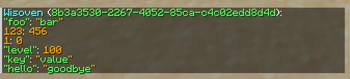
There are multiple debugging tools at your disposal. For example, to easily view an entity's entry, simply run the function mcfentitymap:print_entity as the entity whom you wish to view. This will print their mappings line-by-line in chat.
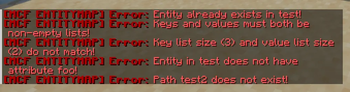
Additionally, this datapack will catch errors and stop execution when they occur. These errors can include, but are not limited to:
- Invalid parameters
- Attempting to access a path that doesn't exist
- Attempting to modify an entry that doesn't exist
By default, these are not shown in chat, but running the function mcfentitymap:settings/show_errors or simply setting your score mcfem.show_errors to 1 will allow you to see in chat when these errors are caught.
If you wish, you can disable error catching entirely by running the function mcfentitymap:settings/disable_errors, but this strongly discouraged and only recommended if error catching poses an actual problem to your project.
To get in contact for any reason, message wisoven on Discord!
MIT licensed.
- Edition: Minecraft Java
- File type: .jar
- Minecraft versions listed: 26.1, 26.1.1, 26.1.2
- How to install: Install the matching mod loader (Forge, Fabric or NeoForge) for your Minecraft version. → Download the .jar. → Put it in the .minecraft/mods folder and launch that loader profile.
- Where to get it: Opens on Modrinth — not every file is mirrored on our own servers.
Install steps are the general flow for this file type — How to install Minecraft Java mods & modpacks walks through it step by step.
- Ships as mcf-entitymap-1.0.1.jar — drop this file into the mods folder
- Download size: 529 KB
- Download link checked 22 Oct 2026 — working
These come from our own check of the pack file, not from the source page.