Villagers can build villages
Transform ordinary villages into evolving communities with autonomous workers, shared resources, specialized professions, construction, agriculture, and…
⬇ Download on CurseForge
Villagers Can Build Villages
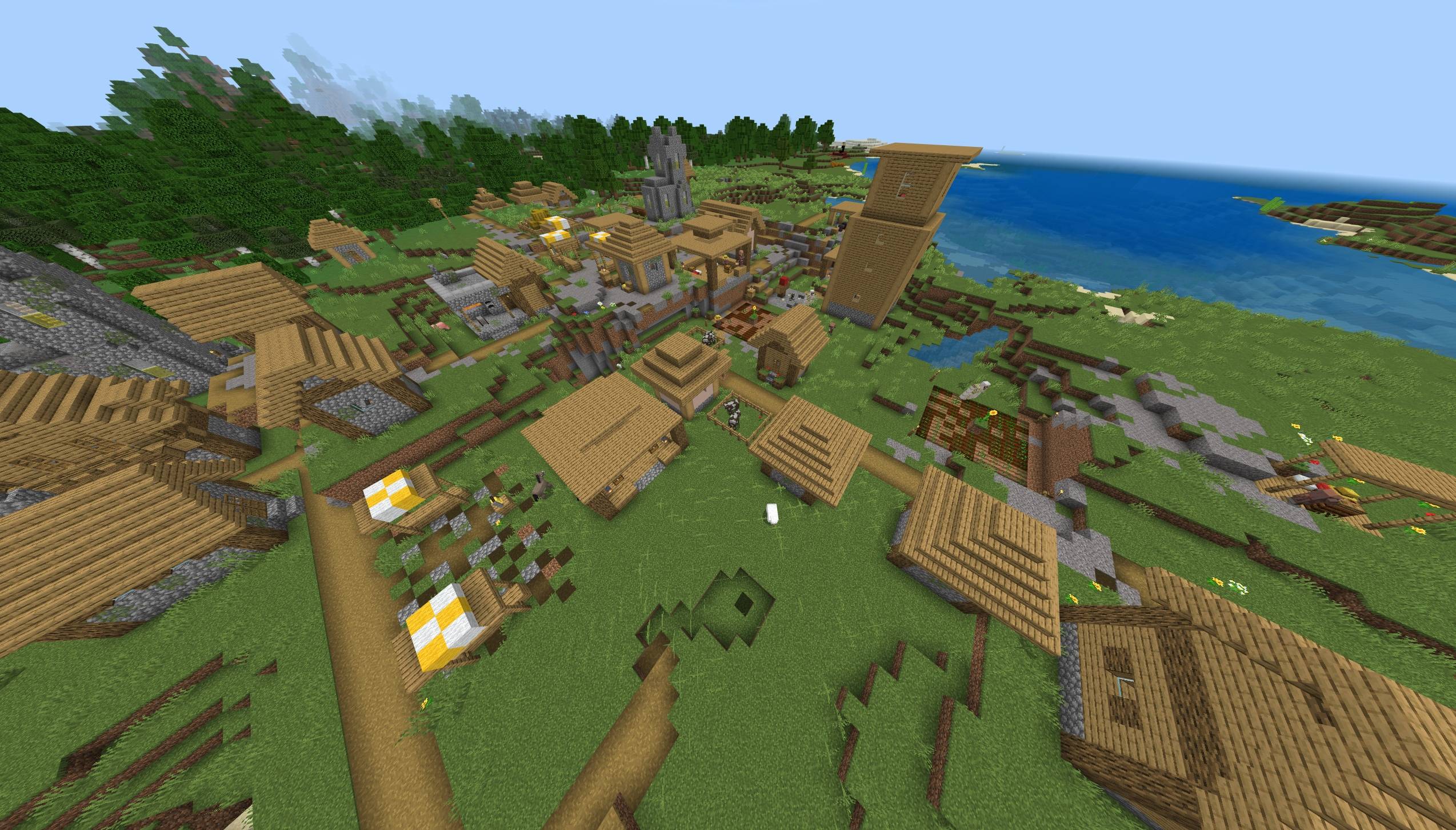
Transform ordinary Minecraft villages into evolving communities powered by agriculture, autonomous workers, specialized professions, shared resources, construction, trade, defense, and village-wide progression.
Villagers Can Build Villages expands villagers far beyond their normal professions.
Villagers can manage internal inventories, harvest and redistribute crops, develop specialized occupations, build new infrastructure, maintain communal storage, raise families, defend their settlement, create roads, operate workshops, and contribute to the development of the village as a whole.
The project is built around one central idea:
A village should behave like a connected community, not a collection of unrelated NPCs.
Agriculture Comes First
Agriculture is one of the foundations of village development.
New settlements attempt to establish farmland and maintain enough farmers to keep the local economy functioning.
At the beginning of village progression, the settlement prioritizes:
-
Farm plots.
-
Adult farmers.
-
Crop production.
-
Seed availability.
-
Food reserves.
-
Agricultural workers.
Additional farmland and farmers become necessary as the village continues to level up.
Automatic farm plots are not generated as completely finished farms. Only a small number of crops are initially planted, leaving the farmers themselves responsible for developing and filling the field over time.
Supported crops include:
-
Wheat.
-
Carrots.
-
Potatoes.
-
Beetroot.
Maritime Villages
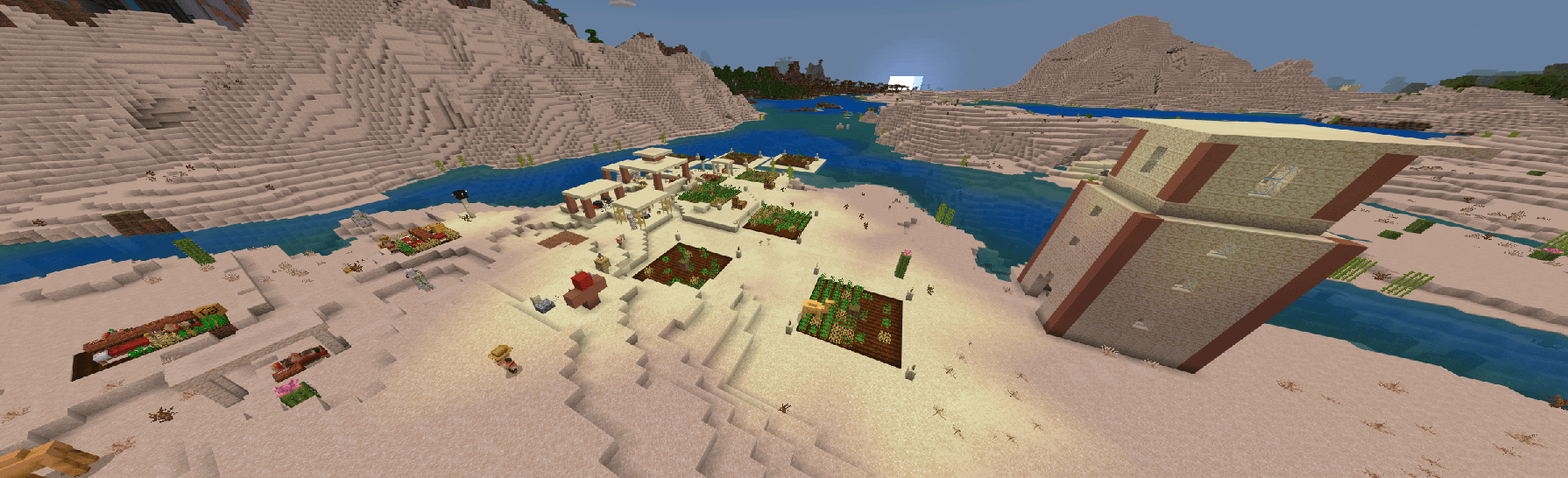
Villages are no longer completely dependent on large areas of flat land.
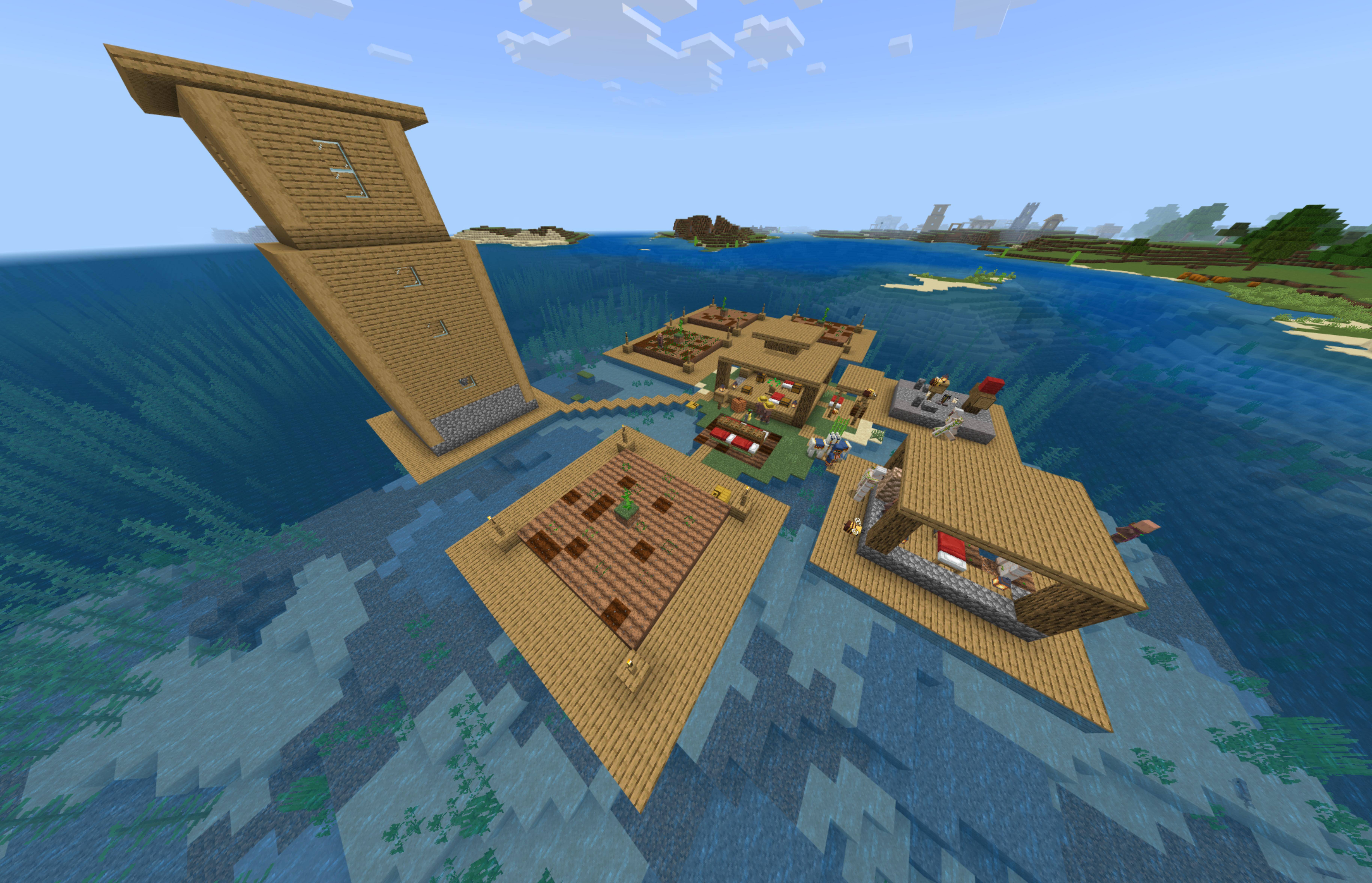
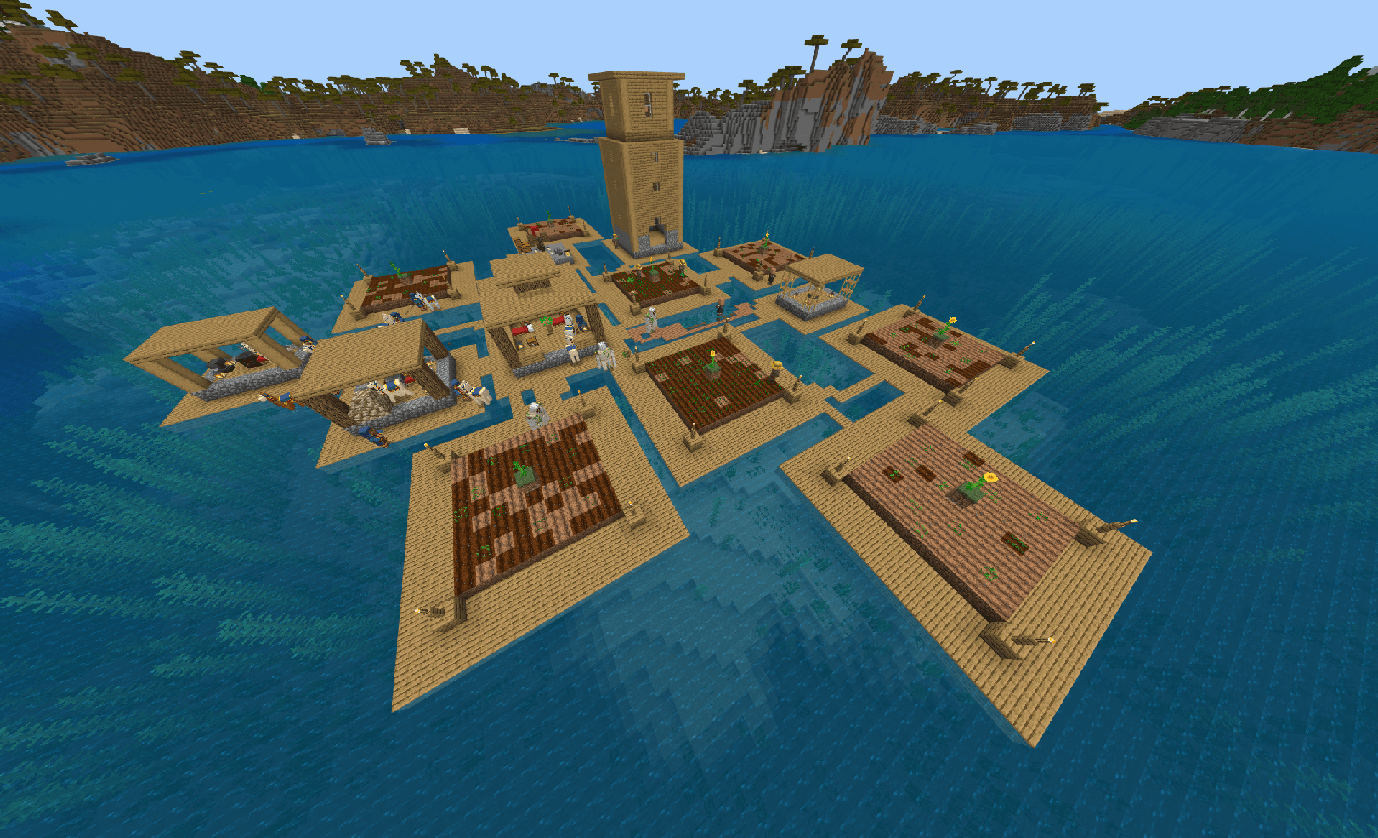
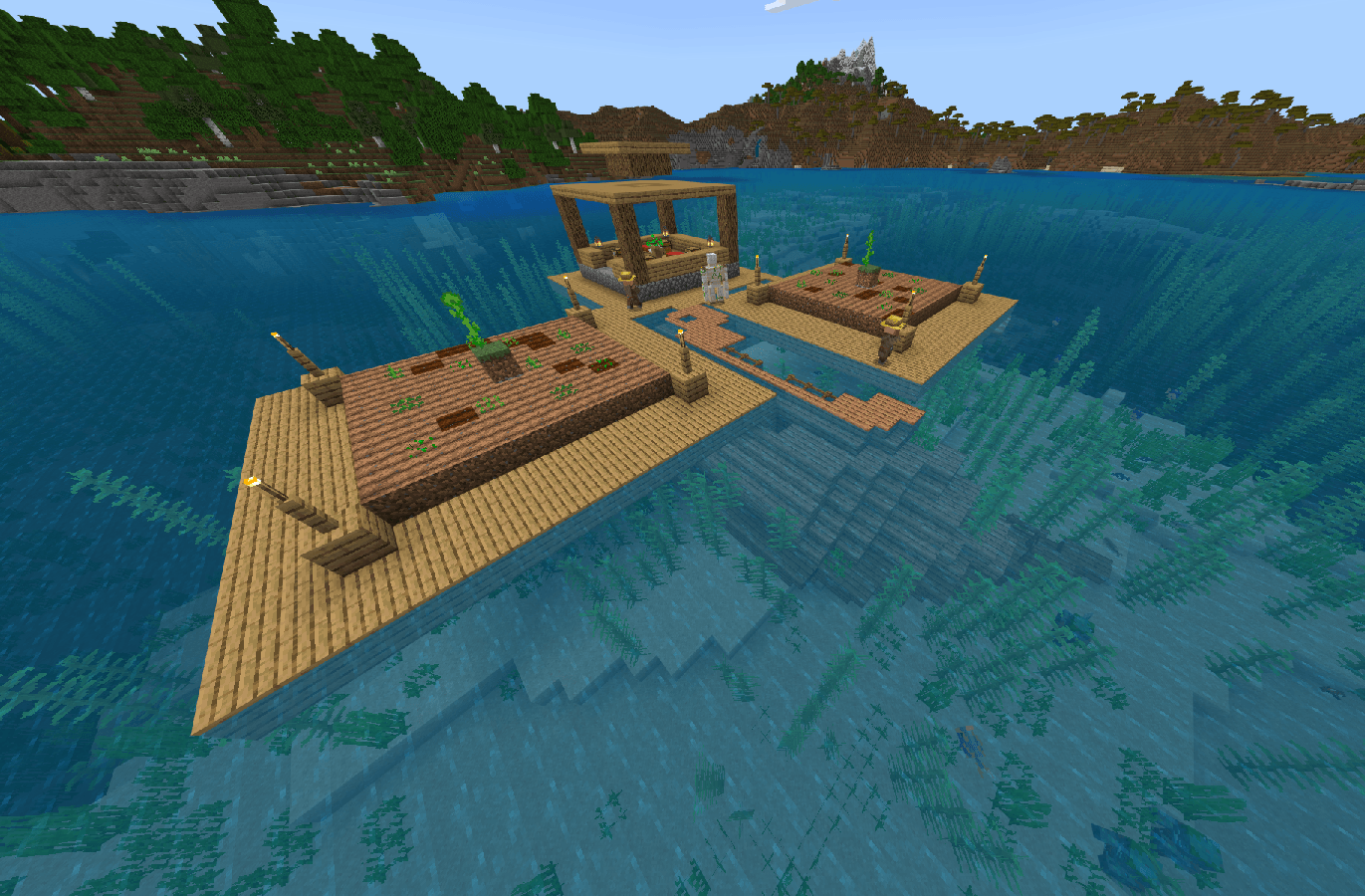
If suitable terrain cannot be found, important infrastructure can use water as a secondary construction area.
Maritime construction can create:
-
Wooden platforms one block thick.
-
Buildings constructed above the water.
-
Agricultural plots built on wooden platforms.
-
Wooden boardwalks connecting isolated structures to the main settlement.
The system prioritizes normal land first.
Water construction is used as a fallback when suitable terrestrial space cannot be found.
Platforms only replace water and compatible aquatic vegetation rather than flattening nearby land.
This allows coastal, island, lakeside, and partially flooded villages to continue expanding instead of becoming permanently stuck.
The Communal Center and Village Registry
Every developed settlement revolves around a Communal Center.
The Communal Center contains the village's special Village Registry lectern, which acts as the main civic information point for the settlement.
The lectern is visually marked with particles so it can be distinguished from an ordinary lectern.
The village attempts to establish this structure from the beginning of its progression rather than treating it as a late-game building.
The Registry provides access to information such as:
-
Village level.
-
Village experience.
-
Agricultural development.
-
Existing infrastructure.
-
Required infrastructure.
-
Specialist professions.
-
Resident information.
-
Village progression.
-
Specialist economy information.
New structures can also create wooden connections toward the Communal Center, helping the expanding settlement remain physically connected to its civic core.
Village Guide
The Communal Center provides access to the Village Guide.
The Village Guide explains the addon directly inside the game, including:
-
How village progression works.
-
How agriculture develops.
-
How automatic construction works.
-
Specialist villagers and their roles.
-
Specialist exchanges.
-
Village roads.
-
Maritime construction.
-
Golems.
-
Peaceful and coercive progression.
-
Raids and hostile equipment.
Players can obtain their own copy and use it as an in-game reference while developing a settlement.
Hidden Villager Inventories
Villagers use internal inventories capable of storing crops, seeds, bread, tools, armor, and other resources.
Players can inspect and manage these inventories using specialized items.
Examples include:
-
Medal of Honor: peacefully inspect a villager's stored items.
-
Assault Knife: forcibly inspect the inventory while damaging the villager.
-
Inventory Lens: examine workers, stored resources, equipment, village progression, registries, and communal systems.
Inventory interfaces allow individual stacks to be withdrawn or entire inventories to be emptied.
Specialist Economy
Advanced village equipment is tied directly to the people who know how to produce or distribute it.
Peaceful and beneficial equipment is primarily obtained by interacting with specialized villagers rather than simply crafting everything at a crafting table.
Specialist exchanges can be opened by interacting with compatible village specialists.
Different professions control different branches of village technology.
Examples include:
-
Seed Collectors: early agricultural equipment and seed-related supplies.
-
Rural Coordinators: agricultural development and communal administration.
-
Agronomists: advanced agricultural progression.
-
Builder Masons: roads and construction-related equipment.
-
Master Toolsmiths: advanced farming tools.
-
Master Armorers and Chief Armorers: defensive and forge-related equipment.
-
Communal Teachers: social development and rehabilitation.
-
Clerics: restoration and family-related systems.
-
Watch Cartographers: surveillance and information equipment.
Some exchanges require the village itself to reach a certain level before the specialist is willing or able to provide the item.
This means village technology develops together with the settlement instead of being completely independent from it.
Peaceful and Coercive Progression
Many systems contain two very different approaches.
The peaceful route uses communal charters, diplomas, manuals, receipts, appointments, and specialist exchanges.
The coercive route uses weapons, decrees, compulsory labor, forced advancement, requisition, and violence.
Examples include:
-
Honorable redistribution or violent expropriation.
-
Peaceful training or mandatory labor.
-
Communal family planning or compulsory birth.
-
Voluntary professional evolution or forced advancement.
-
Restoration of zombie villagers or forced reanimation.
-
Communal equipment upgrades or mandatory rearmament.
Peaceful equipment is associated with the village specialist economy.
Coercive equipment remains obtainable through crafting and can also appear as hostile contraband carried by Illagers.
Pillagers, Vindicators, Evokers, Witches, and Ravagers can provide access to different pieces of coercive equipment.
You can develop a cooperative agricultural commune, an authoritarian production machine, or something deeply questionable between both extremes.
Collective Farming
Farmers can receive assignable sickles with different harvesting areas:
-
Wooden Sickle: 1×1 harvesting.
-
Iron Sickle: 3×3 harvesting.
-
Diamond Sickle: 5×5 harvesting.
-
Netherite Sickle: 6×6 harvesting.
Assigned farmers search for mature crops, harvest them, collect resources, replant farmland, gain progression, and continue working until their sickle breaks.
Their crops and seeds can be:
-
Redistributed between workers.
-
Stored in nearby containers.
-
Collected by specialized golems.
-
Used to support population growth.
-
Used to advance village progression.
Agrarian Reform
The Agrarian Reform Plan can convert suitable terrain into a 9×9 agricultural area.
The center receives an integrated irrigation point.
Automatic village farming uses similar agricultural infrastructure while also allowing terrain adaptation and, when necessary, maritime farm construction.
The goal is to allow agriculture to expand naturally with the settlement instead of requiring the player to manually prepare every individual block.
Specialized Village Professions
Villagers can receive new communal roles that operate alongside ordinary Minecraft professions.
Available roles include:
-
Agronomist: gains agricultural experience and evolves through farming.
-
Seed Collector: gathers and redistributes seeds using additional storage.
-
Foreman: directs workers through coercive authority.
-
Rural Coordinator: provides a cooperative alternative to the Foreman.
-
Builder Mason: develops roads and communal infrastructure.
-
Communal Teacher: supports children, education, and population organization.
-
Master Armorer: manages communal defensive equipment.
-
Chief Armorer: produces and distributes improved armor.
-
Master Toolsmith: equips farmers with suitable sickles.
-
Watch Cartographer: monitors threats and wandering residents.
-
Cleric: performs specialized religious and restorative functions.
Villagers receive persistent identities and role information, allowing settlements to develop recognizable workers rather than an interchangeable crowd of NPCs.
Agronomists and Agricultural Evolution
Agronomists gain personal experience through farming and crop production.
Their progression can be stored, claimed, accelerated, or forced through specialized objects.
Examples include:
-
Agronomy Notebook.
-
Shared Harvest Receipt.
-
Surplus Extractor.
-
Agronomic Mentor Charter.
-
Compulsory Evolution Directive.
-
Agronomic Evolution Act.
Agronomists can evolve repeatedly, making advanced agricultural workers part of the village's long-term development instead of a one-time upgrade.
Farmer Modules
The Farmer Module creates a compact agricultural installation containing farmland, composters, beds, and supporting infrastructure.
Modules can contribute to:
-
Farming zones.
-
Village population growth.
-
Additional farmers.
-
New beds.
-
Workstations.
-
Rest areas.
-
Agricultural storage.
-
Village Iron Golem development.
As the settlement grows, these modules become part of a larger agricultural network.
Shared Village Progression
The addon includes a village-wide progression system connected to the settlement and its Iron Golems.
The village gains shared experience through activities such as:
-
Harvesting crops.
-
Producing bread.
-
Defeating enemies.
-
Developing golems.
-
Villager births.
-
Restoring zombie villagers.
-
Expanding agricultural infrastructure.
-
Cultural contact with Wandering Traders.
Nearby village Iron Golems synchronize their progress as part of the same communal network.
As the level increases, the settlement can unlock:
-
Additional farmers.
-
More farmland.
-
New professions.
-
Construction projects.
-
Defensive systems.
-
Workshops.
-
Storage.
-
Population support.
-
Specialized infrastructure.
Village growth is therefore tied to what the settlement actually produces and develops.
Village Iron Golems
Ordinary Iron Golems become part of village progression.
They can:
-
Accumulate shared village experience.
-
Display village level and progression.
-
Patrol the settlement.
-
Detect hostile creatures.
-
Receive healing from iron.
-
Share progression with nearby village golems.
-
Support milestone rewards.
-
Support new professions and construction projects.
Their development represents the growth of the settlement rather than only the strength of one individual creature.
Oseum Golem
The Oseum Golem is a bone-processing rural worker.
It can:
-
Search for dropped bones.
-
Collect and store bones.
-
Convert bones into bone meal.
-
Locate nearby farmers.
-
Deliver fertilizer.
-
Compost excess seeds.
-
Store bones and bone meal in its internal inventory.
It can be constructed by placing a carved pumpkin directly above a bone block.
Hay Golem
The Hay Golem is an autonomous agricultural worker.
It can:
-
Collect crops and seeds.
-
Harvest mature farmland.
-
Fertilize crops.
-
Replant agricultural areas.
-
Carry resources internally.
-
Deposit materials into nearby chests and barrels.
-
Distribute supplies to villagers.
It alternates between harvesting and depositing depending on its inventory and the needs of the settlement.
Baker Golem
The Baker Golem supports the village bread economy.
It can:
-
Follow and assist farmers.
-
Store wheat and bread.
-
Produce bread.
-
Distribute bread.
-
Supply villagers.
-
Contribute bread production to village progression.
-
Participate in the communal bread bank.
The Inventory Lens can inspect the total amount of bread stored between Baker Golems and village residents and allows the player to withdraw part or all of the reserve.
Communal Storage Network
Villagers and specialized golems can interact with nearby storage containers.
The system can use:
-
Chests.
-
Trapped chests.
-
Barrels.
-
Worker inventories.
-
Golem inventories.
Resources can be:
-
Deposited.
-
Withdrawn.
-
Redistributed.
-
Balanced between workers.
-
Preserved as communal reserves.
Farms and storage areas become part of the village economy instead of remaining decorative buildings filled with manually managed containers.
Foremen and Rural Coordinators
Foremen and Rural Coordinators organize the village workforce.
They can support:
-
Resource redistribution.
-
Agricultural expansion.
-
Farm development.
-
Worker organization.
-
Farmer rest zones.
-
Village granaries.
-
Additional production infrastructure.
-
New collectors and support workers.
The Foreman represents the coercive route.
The Rural Coordinator provides a more cooperative alternative.
Seed Collectors
Seed Collectors specialize in gathering and supplying planting materials.
Their baskets provide additional storage and allow them to:
-
Gather seeds.
-
Maintain reserves.
-
Deliver seeds to farmers.
-
Support new farmland.
-
Reduce shortages during agricultural expansion.
Additional collectors can appear as the settlement develops.
Communal Teachers and Population
Communal Teachers support children and population development.
The addon includes systems for:
-
Planned births.
-
Forced births.
-
Child development.
-
Accelerated maturity.
-
Population milestones.
-
Bed and food requirements.
-
Farmer recruitment.
-
Role distribution as the population grows.
Village growth is connected to infrastructure, communal food, available beds, professions, and shared progression.
Nitwit Rehabilitation
Nitwits can be rehabilitated into useful members of the settlement.
Players can choose between:
-
Villager Training Manual: peaceful rehabilitation.
-
Mandatory Labor Decree: coercive conversion.
Some villagers may remain permanent nitwits when they cannot be successfully integrated.
Zombie Villager Restoration
Zombie villagers can be restored through specialized progression items.
The two main approaches are:
-
Villager Restoration Charter: peaceful restoration.
-
Perpetual Reanimation Decree: coercive reanimation.
Successful restoration contributes substantial experience to village progression.
Armor and Tool Management
Specialized smithing professions can manage communal equipment.
Armorers can:
-
Progress through equipment stages.
-
Distribute armor to residents.
-
Provide improved defensive equipment.
-
Maintain an armor registry.
Master Toolsmiths can:
-
Track farmer equipment.
-
Assign sickles.
-
Replace missing tools.
-
Match sickle quality with village progression.
-
Maintain a tool registry visible through the village information systems.
Advanced equipment is connected to the specialist exchange economy.
Forge Hammers
Two forge tools represent different approaches to repairing village defenders:
-
Communal Forge Hammer: supports village golems through a cooperative area effect.
-
Coercive Forge Hammer: provides a more violent alternative.
Forge progression can eventually support specialized workshops, armorers, and improved communal defenses.
Village Roads and Boardwalks
Builder Masons can create roads based on village policy.
Available road systems include:
-
Dirt paths.
-
Gravel roads.
Masons observe frequently traveled routes and gradually improve suitable terrain while avoiding protected farmland and important village structures.
Wooden connections are also used by automatic village construction.
When possible, new structures attempt to connect toward the central Village Registry.
Maritime structures can create wooden boardwalks across water to reconnect isolated farms and buildings with the rest of the settlement.
Automatic Village Construction
As the settlement develops, villagers can automatically construct infrastructure.
Possible constructions include:
-
9×9 farm plots.
-
Farmer Modules.
-
Farmer rest zones.
-
Granaries.
-
Bee stations.
-
Light towers.
-
Cleric shrines.
-
Mason yards.
-
Forge workshops.
-
Toolsmith workshops.
-
Cartographer watch towers.
-
The Communal Center and Village Registry.
Agriculture receives particular priority during early development.
Construction first searches for usable terrain and can adapt moderately uneven natural ground.
Important structures can progressively search farther away if nearby terrain is unsuitable.
When terrestrial space is unavailable, compatible structures can use wooden maritime platforms instead.
Workers are selected for construction tasks and travel toward projects before construction is completed.
The resulting settlement grows according to its level, population, professions, agriculture, and accumulated production.
Watch Cartographers
Watch Cartographers operate defensive observation towers.
They can:
-
Detect nearby enemies.
-
Sound alarm horns.
-
Alert village defenders.
-
Extend the surveillance area.
-
Detect residents and golems that wandered too far.
-
Guide lost members toward the settlement.
Multiple towers can expand the defensive awareness of large villages, while their construction is spaced through village progression rather than appearing all at once.
Cleric Shrines and Memorials
Clerics can eventually establish communal shrines.
These structures serve as religious and restorative landmarks and contain small memorial areas.
Additional shrines are deliberately spaced far apart in village progression so developing settlements do not become overwhelmed by repeated graveyards.
Inventory Lens
The Inventory Lens is one of the main information and management tools for developed villages.
It can display:
-
Villager inventories.
-
Available and occupied slots.
-
Food and seed quantities.
-
Assigned sickles.
-
Basket storage.
-
Village level and experience.
-
Oseum Golem resources.
-
Baker Golem bread and wheat.
-
Resident registry.
-
Armor registry.
-
Tool registry.
-
Village bread bank.
The Lens also controls many informational messages from the addon, reducing constant notifications when the player does not need them.
Designed for Long-Term Villages
Villagers Can Build Villages is intended for players who want settlements to become ongoing projects rather than static collections of houses.
A small village can gradually develop into an agricultural community containing:
-
Farmers.
-
Seed Collectors.
-
Agronomists.
-
Coordinators or Foremen.
-
Teachers.
-
Smiths and Armorers.
-
Masons.
-
Clerics.
-
Watch Cartographers.
-
Specialized rural golems.
-
Shared farms.
-
Communal storage.
-
Roads and boardwalks.
-
Workshops.
-
Defensive towers.
-
Maritime infrastructure.
-
A central Communal Center.
-
A Village Registry.
-
A specialist economy.
-
A village-wide progression system.
The player can cooperate with this development, accelerate it through administrative tools, or control it through requisition and coercion.
Development and Feedback
Villagers Can Build Villages focuses on expanding:
-
Villager inventories.
-
Autonomous agriculture.
-
Village management.
-
Worker specialization.
-
Specialist trading.
-
Golem utility.
-
Communal storage.
-
Population growth.
-
Automatic settlement construction.
-
Maritime settlement expansion.
-
Roads and infrastructure.
-
Defensive organization.
-
Long-term survival progression.
Bug reports, balance feedback, compatibility reports, screenshots, videos, and suggestions are welcome in the project comments.
Build a cooperative commune, establish an authoritarian farming state, construct a village over the ocean, or create something deeply questionable between all three. The village will remember the paperwork either way.
- Edition: Minecraft Bedrock
- File type: .mcpack or .mcaddon
- Minecraft versions listed: 26.20, 26.30, 26.40
- How to install: Download the .mcpack or .mcaddon file. → Open it — Minecraft imports it. → In your world: Behavior Packs → Available → Activate, then the same under Resource Packs.
- Where to get it: Opens on CurseForge — not every file is mirrored on our own servers.
Install steps are the general flow for this file type — How to install Minecraft Bedrock addons & mods walks through it step by step.
Villagers can build villages is a free Minecraft Bedrock addon. Compatible with Minecraft 26.20, 26.30, 26.40, 26.50. Downloaded 13,985 times (via CurseForge). Download it and open it directly in the game.