
Timeworn
Java data pack listed for Minecraft 26.x. Downloads from the MC Java Mods app on Android.
Your world ages. Paths wear in where you walk and fade when you stop. Stone cracks, moss spreads, dead trees fall. Ruins and barrows of people who came…
⬇ Download on Modrinth


Timeworn
Walk the same route enough times and the grass gives out under you.
That is the whole idea. Not a seasons mod, not a difficulty slider. One rule, applied honestly: the world remembers what you did, and what you stopped doing.
No dependencies. No resource pack. Nothing to edit in a text file.
What actually happens
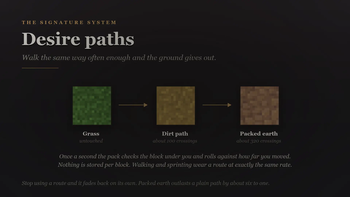
The ground gives way where you walk. Grass wears to dirt path, dirt path packs down to mud. There is no counter on any block; the odds are simply higher on ground you cross often, which is what a desire path is. The line between your door and your mine turns up on its own after a few in-game weeks. Walk it three abreast and it widens.
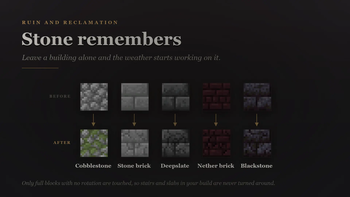
Stone you leave alone ages. Cobblestone goes mossy. Brick cracks, then goes mossy, then gives up and falls back to rubble. Polish wears off. It lands in patches about three blocks across, so a wall ages unevenly instead of flipping all at once.
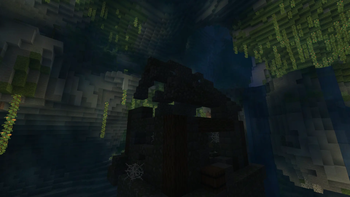
Rooms nobody visits fill up. Cobwebs in the corners where a ceiling meets a wall. Glow lichen overhead. Vines on stonework outside, leaf litter on the ground, moss creeping over stone. A room that has been collecting webs for a long time sometimes collects a spider as well.
Much later, things stop being what they were. Glass clouds over. Timber dulls one shade at a time down a ladder measured from the plank textures themselves. The most weathered cobblestone crumbles to gravel, and gravel falls. Ice nobody breaks packs down into a glacier and stops melting. Mud that never dries compacts into clay. The cut goes out of sandstone. Mine any of it and you get what it became, not what it started as.
A road old enough shows its bones. Walk a route until the ground under it has gone hard, and now and then a stone comes up beside it. Nothing carried it there; it was under the field the whole time and the track wore the ground off it.
Thirteen smaller marks. Stone weeps and grows a point in the dark, and what drips off the ceiling builds back up from the floor. Sand piles against whatever stops the wind. Water nothing disturbs stops being water anybody would drink. A stone face does not stay a face; what comes off it gathers at the foot.
Paths nobody uses fade. Stop walking a route and it goes back to dirt, and vanilla grass does the greening from there.
Living trees are left out of all of it. A trunk and a roof beam are the same block, so the pack checks for leaves before it touches wood.
The long game
Away from anywhere you have settled, the world starts putting things up.
Ruins. Six kinds, three versions each, turned to any of four bearings. Houses, towers, halls, wells, cellars, watchposts. Weathered, overgrown, and carrying whatever the country around them imposes. Some have a book in them. Some have words cut into a wall.
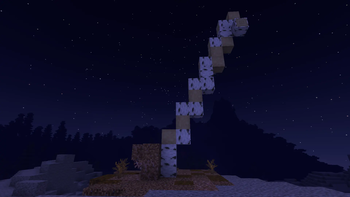
Dead wood. A snag still standing with its bark sliding off in sheets. A trunk that came out of the ground on one side and stopped halfway down. A stump with the length of itself lying beside it. Timber the pack is allowed to age, since living trees are not.
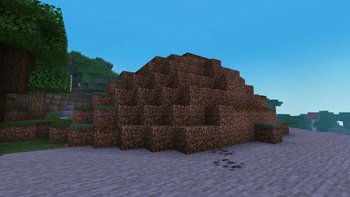
Old works. Nine standing stones with lintels dropped across them, and long barrows you can walk into. Both were here before the houses.
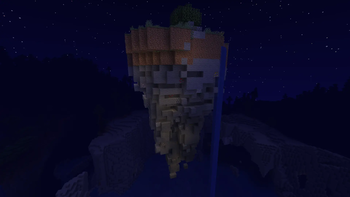
Floating islands. Ground that never came down. Soil on top going to rock below, ore in the keel, vines on the underside, and a pond that spills over the rim and falls all the way to the ground, which is how you get up there.
Cairns. A few stones stack themselves where somebody died, and weather over.
Somebody was here before you
Three books, fourteen torn writings and fifteen things cut into walls, scattered across everything above. None of them explains anything. Between them they give it away: what the nine stones were for, what the small brass thing did, why it was a mistake, and what you are supposed to do about it.
There is a rite. It is described, in pieces, in several places. Nobody tells you it exists.
Nights
Days since your last death drive how well armed the dark is. Below five days nothing changes. Past that, mobs arrive quicker, then better equipped, then carrying something worth taking off them. Past twenty-five days the nights start sending something that does not tire.
Every mob is measured against whoever it is standing nearest, not against the best-geared player on the server. Two people on the same world walk out into genuinely different nights.
Some nights are their own event: a blood moon, a still night with nothing in it at all, an eclipse, a storm front, a fall of grey ash that ages the world twice as fast while it lasts. Whatever walks on those nights has a fair chance of wearing something, and each kind of night has its own face. They come off about one time in sixteen.
Thirty-five advancements, in their own tab. Most are handed out when the pack notices something rather than when you craft something.
All of it is optional
/trigger tw.menu opens a settings menu in chat. Three pages, one click a row,
plain names instead of raw numbers. It runs on a trigger, so players can change
settings on a server without operator permissions and without cheats.
Every system has its own switch. Rates are adjustable. If you want the paths and nothing else, that is two clicks.
What it costs
Measured on a dedicated 26.2 server with /tick query:
| Average tick | |
|---|---|
| Pack disabled | 0.1 ms |
| Pack enabled, idle | 0.2 ms |
| Sweep at its highest setting, three points, every tick | 1.2 ms |
That last row is twenty times the rate the pack ever actually uses, and it aged 1043 blocks while it was running, so it was doing real work. Against a 50 ms tick budget the pack's real cost is a rounding error.
The big builds are saved structures placed by the game in one command, not a few thousand replayed setblocks. Nothing iterates chunks. Nothing looks outside a radius around a player. Work is capped by selector limits, so a server with forty people on it does the same work per second as one with four.
Install
Drop the timeworn folder into <world>/datapacks/, then reopen the world or
run /reload.
Updating
Replace the folder and reload. Settings you changed are kept. Anything the new version adds arrives turned on, and anything you deliberately switched off stays off.
Uninstall
Run /function timeworn:uninstall, then delete the folder and reload. It hands
back every scoreboard objective, marker, boss bar, stored value and forced chunk
it ever took. Verified on a live server, not assumed.
Everything the pack does to blocks is cosmetic and reversible by hand. It never replaces a block you placed.
Compatibility
Minecraft 26.2. Vanilla only, no dependencies, no mixins, no resource pack. Multiplayer safe: state is per player where it should be, and shared where it should be.
- Edition: Minecraft Java
- File type: .jar
- Minecraft version listed: 26.2
- How to install: Install the matching mod loader (Forge, Fabric or NeoForge) for your Minecraft version. → Download the .jar. → Put it in the .minecraft/mods folder and launch that loader profile.
- Where to get it: Opens on Modrinth — not every file is mirrored on our own servers.
Install steps are the general flow for this file type — see the MC Java Mods guides for the full walkthrough.
- Downloads as timeworn-1.0.0.zip
- Download size: 266 KB
- Download link checked 15 Oct 2026 — working
These come from our own check of the pack file, not from the source page.